
EXPERIENCE LEADER · CX, EX & UX · FINANCIAL SERVICES

I make complex experiences clearer, easier, and more human.

I connect research, Voice of Customer, service design, digital product strategy, and operations—then help organizations turn insight into decisions people can feel and businesses can measure.

Stacey Collins — Better. On Purpose. A sunlit design workspace with journey sketches and a note asking what if?
Understanding people. Seeing the system. Designing the change.
20+ yearsFinancial-services leadership
10,000+Monthly VoC insights
50%+ → ~7%Lending call abandonment
5 years → 45 daysMeaningful engagement

Experience is not a department. It is how an organization learns.

The best experience work does more than improve a touchpoint. It gives teams a shared understanding of people, makes tradeoffs visible, and creates the operating discipline to act. My role is to connect those pieces—from discovery to delivery, from frontline reality to executive decisions.

From insight to measurable change

Five stories spanning research, journeys, digital products, communications, and service operations.

Work is summarized and reconstructed to respect member, customer, and organizational confidentiality.

02

BECU

Turning an inactive-account problem into an engagement opportunity

The work began as an effort to eliminate the required $5 member share hold for indirect auto borrowers. Following the account lifecycle revealed a larger opportunity: engage these new members while the lending relationship was still active.

Role
Member Experience leader · Initiative lead
Member segment
Indirect auto borrowers acquired through the CUDL network
Partners
Marketing · Lending · Product · Operations
Evidence
Account lifecycle · Loan-payoff behavior · Engagement research · Journey data

EXECUTIVE MANDATESelected by the EVP, Retail and Experience, and CEO to explore the case

DECISION FORUMPrioritization Steering Committee · Approval secured

CROSS-ORGANIZATIONAL REACHLegal · Compliance · Finance · Marketing · Engineering · Deposit Operations · Frontline

The operating problem

After an indirect auto loan was paid off—on average in about three years—the required share account remained open, creating inactive accounts that could become dormant and eventually subject to escheatment.

The connection

Marketing was simultaneously working to improve engagement in the same segment. Connecting the two efforts reframed a carrying-cost issue as a relationship-design opportunity.

What changed

Our research strengthened the case for an optimized onboarding campaign designed around early utilization rather than waiting years for members to engage.

Explore the full BECU case

The best solution addressed more than the original problem.

BECU had a healthy indirect auto portfolio as a preferred lender through CUDL. But the membership structure created a long tail of $5 share accounts after borrowers paid off their loans. I connected that lifecycle problem with Marketing's work on engagement, giving both efforts a stronger case for action.

  1. 01 · DiagnoseStart with account cost

    Examined the cost and obligations associated with retaining inactive $5 member share accounts.

  2. 02 · TraceFollow the lifecycle

    Mapped the path from CUDL-funded auto loan through payoff, dormant share account, and potential escheatment.

  3. 03 · ConnectJoin related work

    Linked the effort to Marketing's goal of moving engagement from 20% to 40% and reducing a five-year time to engagement.

  4. 04 · ReframeStrengthen the case

    Used the research to show that better onboarding could create earlier value while the lending relationship was active.

  5. 05 · MeasureConfirm the shift

    The optimized campaign doubled engagement and reduced time to meaningful engagement to 45 days within one year.

$5Required member share hold behind the original case
~3 yearsAverage time to auto-loan payoff
+20 pointsEngagement improvement, from 20% to 40%
45 daysTime to meaningful engagement after implementation
“The original problem was the cost of an inactive account. The larger opportunity was helping a new member find value before the loan was gone.”Leadership reflection

Case narrative reconstructed from original program results; member information and proprietary campaign materials are not reproduced.

03

TRAVELERS

Making required claim communications easier to understand

Claim correspondence had to serve customers, claim professionals, agents, legal requirements, multiple lines of business, and several delivery channels. I led a cross-functional effort to redesign the communication system—not simply rewrite individual letters.

Role
Initiative lead · Co-facilitator
Cohort
Customer Experience · Auto Claim · Property Claim · Claim Analytics · Claim Legal
Methods
Discovery · Workshops · Collaborative content design · A/B comparison pilot
Enterprise scope
3 product lines · 17 field offices · 150 communications

LEADERSHIP SCALEAVP · Five-member cohort lead and practitioner

DECISION FORUMSClaim Executive Team · Enterprise Communications

The challenge

Dense, fragmented correspondence made complex claim decisions harder to understand and generated avoidable customer calls.

My leadership

Led the work and co-facilitated design and writing with a cross-functional cohort spanning experience, claims, analytics, and legal.

What changed

Separated customer-facing and legally required content, strengthened hierarchy and tone, clarified next steps, and designed for multiple channels.

Designing, testing, and scaling clearer correspondence

The work connected customer comprehension with operational effort, legal requirements, employee workflow, and technology. The team established the strategy together, created representative communications, and tested whether clearer design changed customer behavior.

  1. 01 · DiscoverUnderstand the system

    Gathered correspondence, requirements, customer signals, and line-specific context before workshops.

  2. 02 · ConveneWork across disciplines

    Co-facilitated on-site sessions with experience, Auto, Property, Analytics, and Legal partners.

  3. 03 · DesignCreate and critique

    Used deep dives and sample outputs to develop clearer content, hierarchy, tone, and calls to action.

  4. 04 · ValidateMeasure behavior

    Compared the original and redesigned letters through a 100-claim A/B pilot.

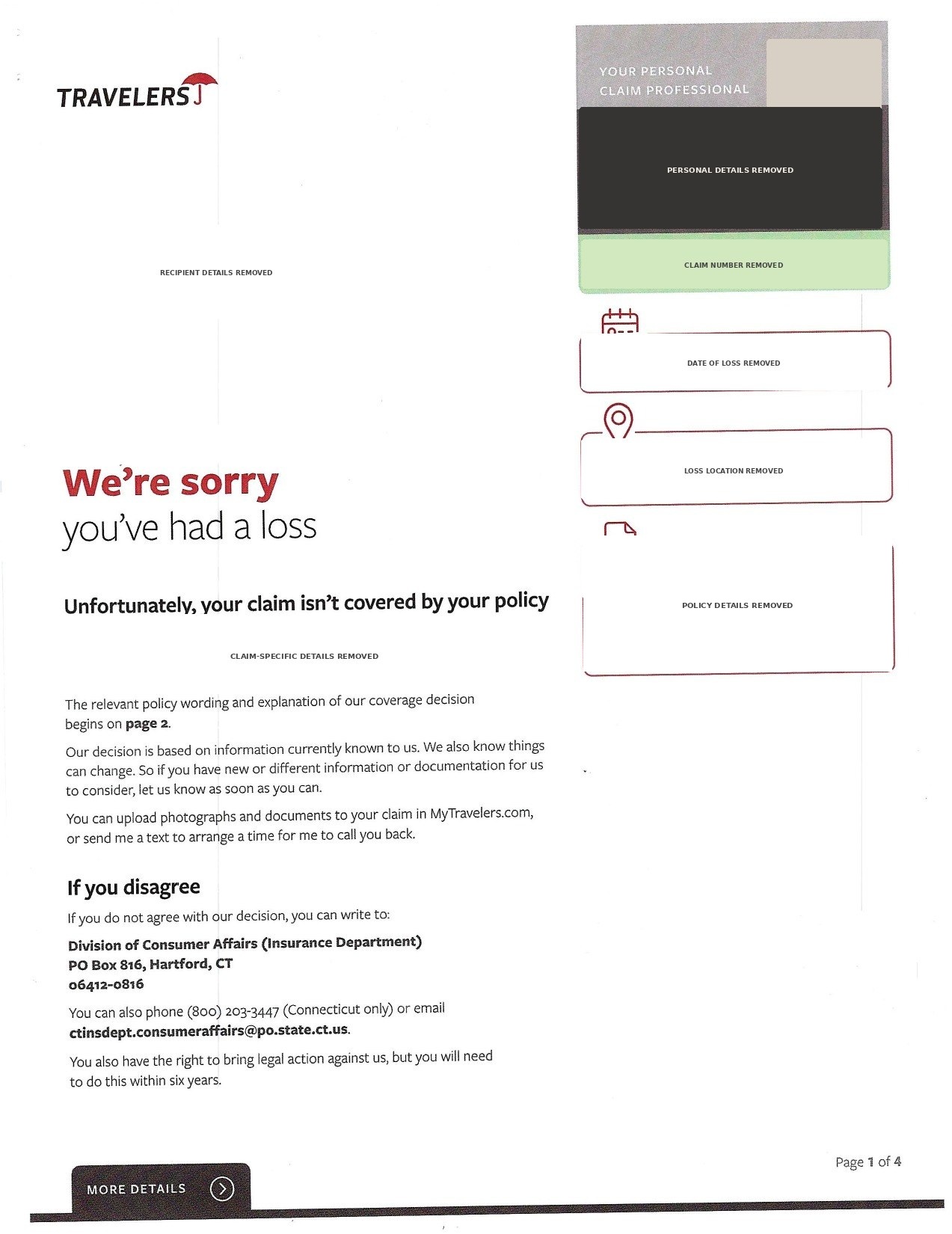
Page one of a redesigned Travelers property claim denial letter with an empathetic headline, claim professional contact card, and scannable claim facts01 · LEAD WITH THE DECISION

Empathetic language, a clear coverage decision, immediate access to the claim professional, and the most important claim facts appear before the legal detail.

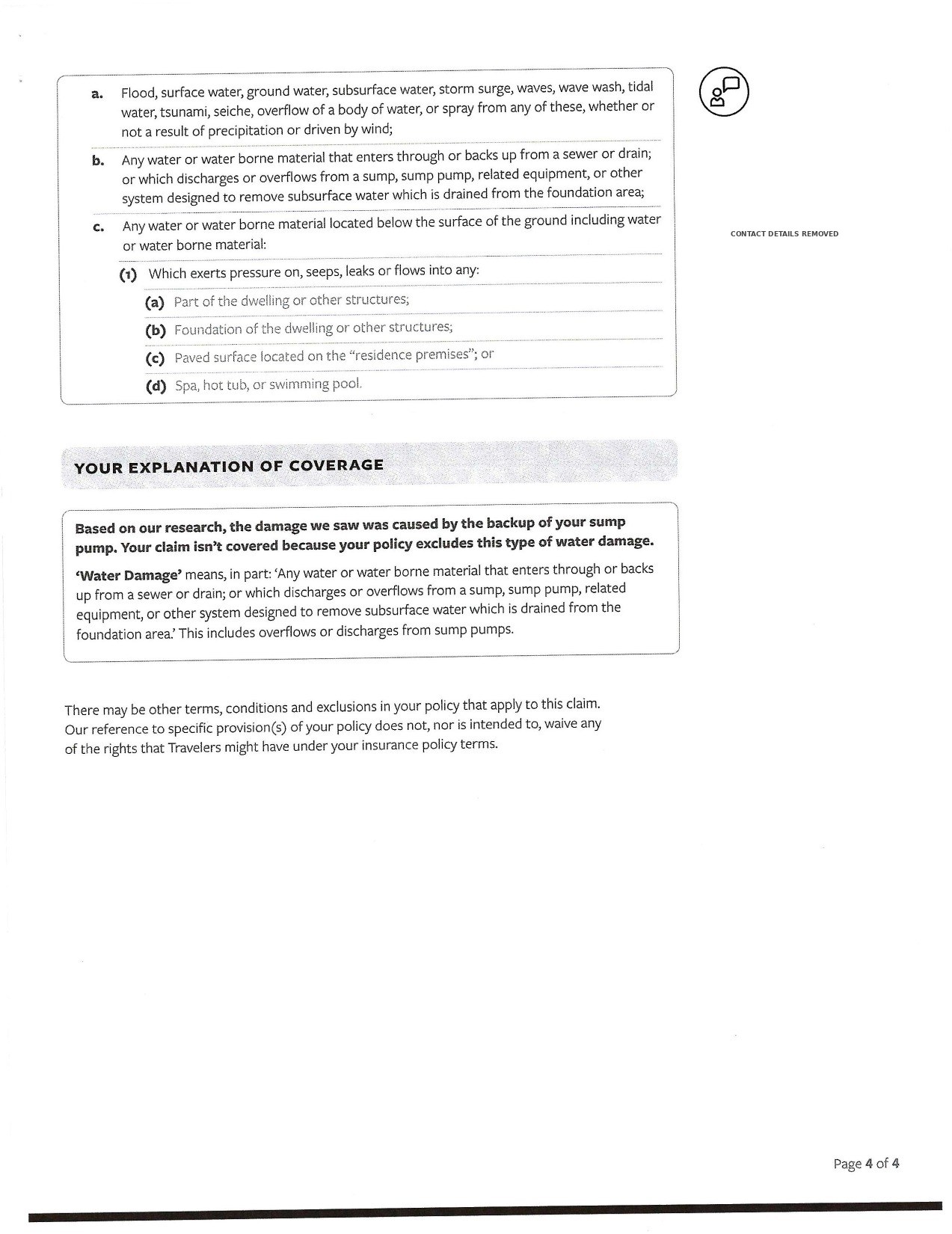
Final page of the redesigned Travelers property claim denial letter with policy language, a plain-language coverage explanation, and contact information04 · EXPLAIN THE WHY

Required policy language is paired with a concise explanation of how it applies to the customer’s specific loss.

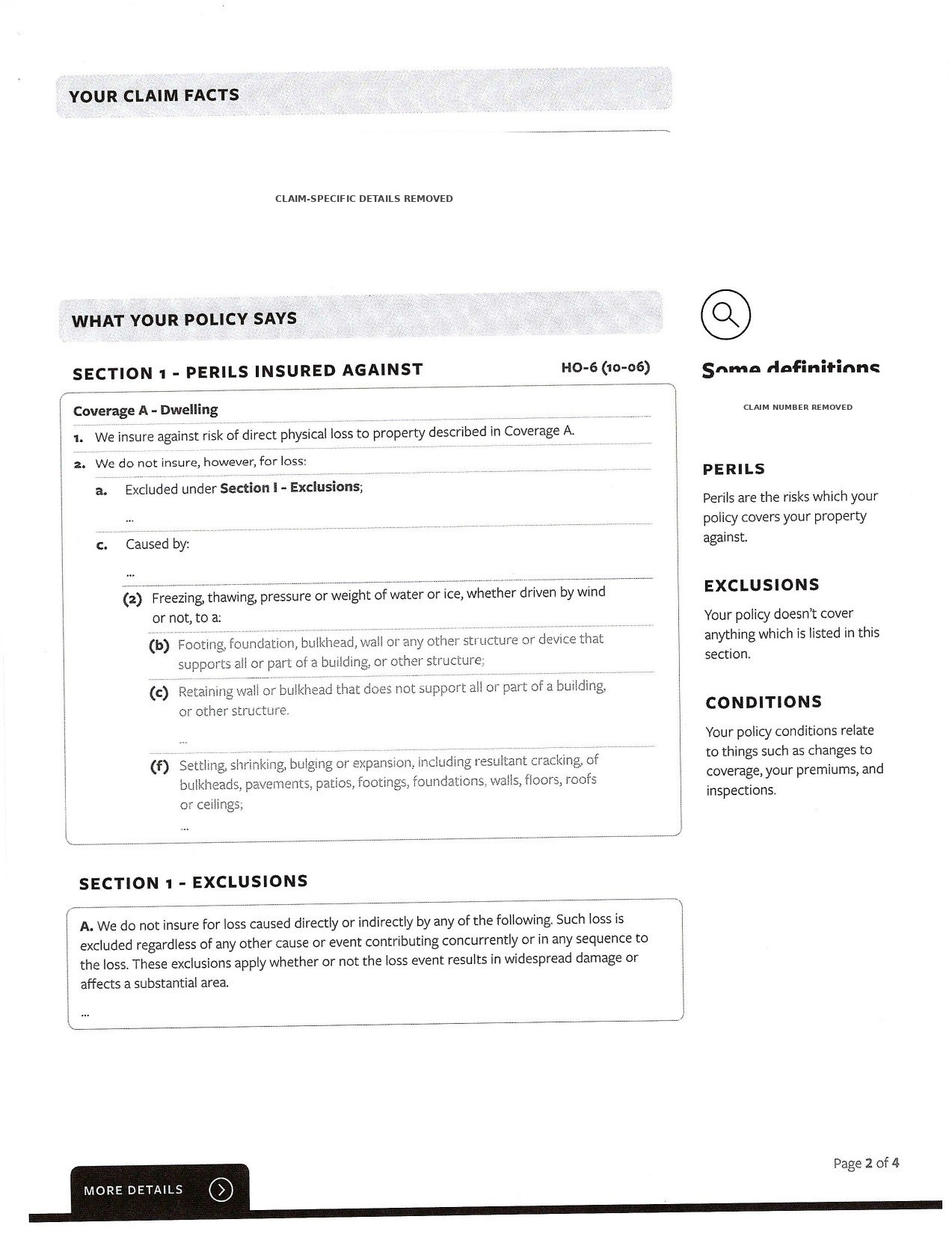
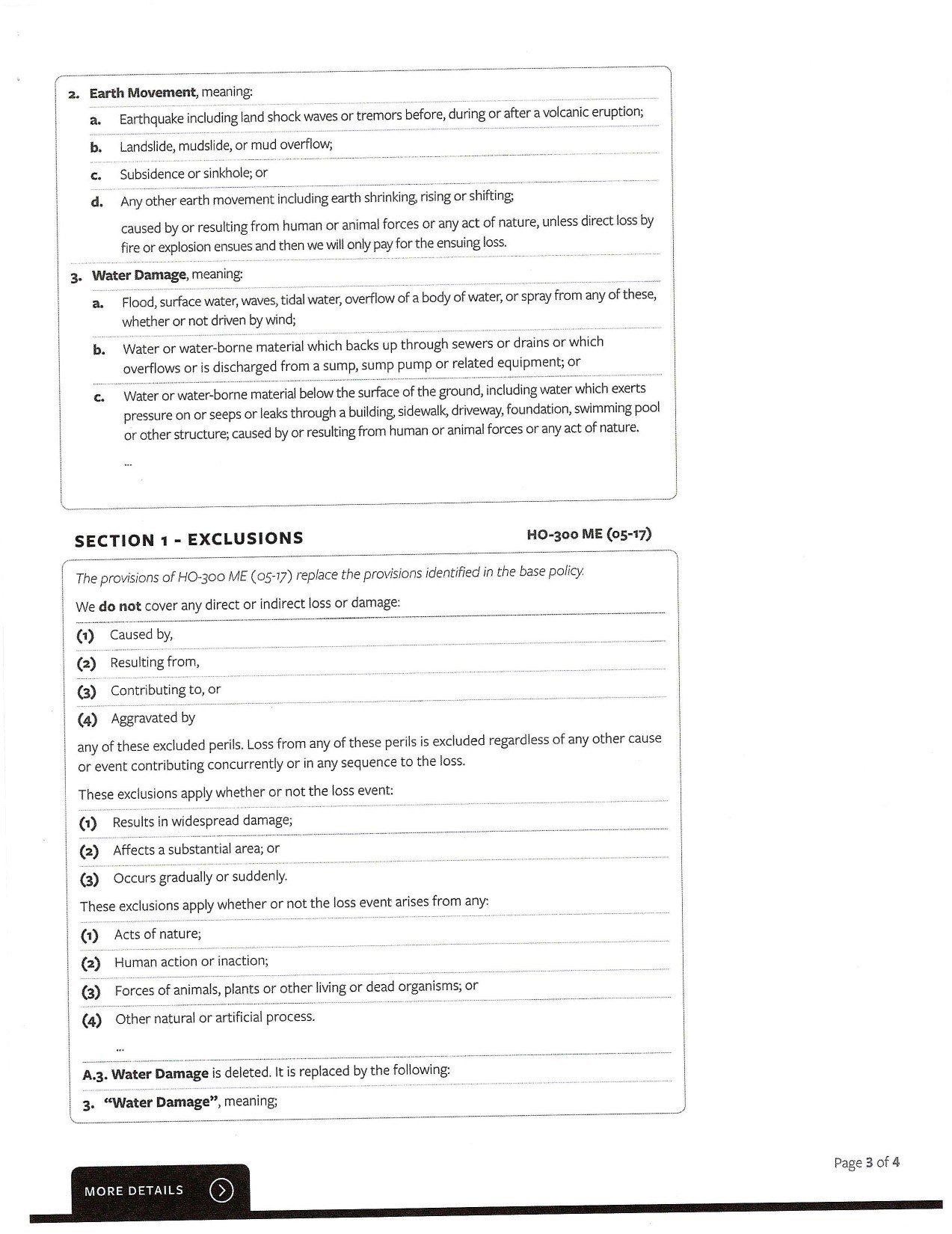
Page two of the redesigned Travelers claim letter showing claim facts, policy excerpts, and definitionsPage three of the redesigned Travelers claim letter showing additional policy exclusions

02–03 · PRESERVE THE RECORD The middle pages retain the complete policy rationale while using sections, definitions, and visual structure to support navigation.

Four-page prototype denial correspondence. Identifying and claim-specific details have been obscured.
ORIGINAL CORRESPONDENCE
Information was present. Understanding was not assured.
  • Dense required content
  • Weak information hierarchy
  • Important next steps competed for attention
  • 67% called after receiving the letter
REDESIGNED CORRESPONDENCE
Structure the message around what the customer needs next.
  • Plain-language payment headline
  • Prominent claim-professional contact
  • Scannable claim details and next steps
  • 14% called after receiving the letter
100Like-for-like property claims below $5,000
50 / 50Original letter / redesigned letter
53 pointsLower post-letter call rate
~79%Relative reduction in customers calling

Identifying and claim-specific details have been obscured. Pilot results are directional and reflect the tested cohort.

04

Following consumer behavior to the problem that mattered

The work began as a consumer P2P study. Research revealed a more consequential issue: DCU's top depositors were also bill-pay super users, and their sentiment was declining because too few billers could be paid the same day.

Role
Manager, Member Experience · UX team leader
Audience
Consumer banking members
Methods
Contextual interviews · Keyword desirability · Scripted usability study · System Usability Scale
Partners
Product leadership · Bill payment vendor · Technology · Operations · Risk

LEADERSHIP SCALESix-member cohort lead

DECISION FORUMSMember Experience leadership · Product leadership · Bill payment vendor

Initial question

Understand the consumer P2P experience and identify opportunities to improve digital money movement.

Research-led pivot

Behavior and sentiment pointed beyond P2P to bill pay—a high-frequency service used heavily by some of DCU's most valuable depositors.

From evidence to action

I presented the case to product leadership and the bill payment vendor, resulting in a joint effort to optimize the service around the needs our research revealed.

Explore the full DCU case

Start with the hypothesis. Follow the evidence.

The study combined qualitative context with structured usability measures. Instead of forcing the findings into the original P2P brief, I used the evidence to reframe the opportunity around consumer bill pay, relationship value, and same-day payment expectations.

  1. 01 · FrameBegin with P2P

    Defined the initial consumer money-movement question and the behaviors the study needed to explore.

  2. 02 · LearnCombine depth and structure

    Used contextual interviews, desirability language, scripted usability tasks, and SUS to capture expectations, behavior, and perceived ease.

  3. 03 · ConnectFind the valuable segment

    Linked the research to relationship behavior and found that top depositors were disproportionately heavy bill-pay users.

  4. 04 · InfluenceBring evidence to leaders

    Presented the case to product leadership and the bill payment vendor, reframing the opportunity around same-day coverage.

  5. 05 · ActOptimize together

    Catalyzed a joint effort with the vendor to improve the bill payment service based on the research.

“The leadership move was not answering the original question faster. It was recognizing that the evidence had revealed a better question.”Leadership reflection

Methodology reconstructed from original research materials. Internal screens, member information, and proprietary findings are not reproduced.

05

NUTMEG STATE FEDERAL CREDIT UNION

Designing the conditions for frontline talent to stay

Frontline attrition was high, disrupting service consistency, institutional knowledge, and the member experience. Yet the usual explanation did not hold: employees wanted to stay. Exit interviews and engagement feedback showed that affordability and limited paths for advancement—not commitment to Nutmeg—were driving people away.

Role
People and frontline executive · Initiative lead
Evidence
Exit interviews · Employee engagement survey · Hiring and attrition data
Analysis
Talent structure · Compensation bands · Job architecture · Advancement paths
System levers
Pay · Benefits · Job families · Role clarity · Development

LEADERSHIP SCALEExecutive sponsor and business-case lead

DECISION FORUMSExecutive Team · Board

The presenting problem

Frontline retention was approximately 50%, creating recurring hiring pressure, lost knowledge, and avoidable disruption to member service.

The insight

Employees' desire to remain was high. Compensation and benefits affected affordability, while the talent structure made advancement difficult to see or achieve.

The response

I presented a phased workforce strategy: increase frontline salary bands, build job families, modernize job descriptions, and create development opportunities both within and beyond each role.

Explore the full Nutmeg case

The issue was not whether people wanted to stay. It was whether staying was sustainable.

I treated attrition as an experience and systems problem. The work connected employee voice with compensation data, organizational structure, role design, leadership development, and business continuity—then translated those findings into a practical, phased investment case.

  1. 01 · ListenHear the reasons

    Combined exit interviews with employee engagement feedback to understand why frontline employees were leaving.

  2. 02 · DiagnoseSeparate intent from constraint

    Found strong desire to stay alongside real affordability pressure and limited visibility into advancement.

  3. 03 · AnalyzeStudy the system

    Examined compensation, benefits, job structure, hiring, attrition, internal movement, and critical-role continuity.

  4. 04 · DesignCreate viable pathways

    Proposed gradual salary-band increases, job families, modern job descriptions, and development within and across roles.

  5. 05 · AlignConnect talent to strategy

    Built leadership support for a workforce model that strengthened employee viability and organizational performance together.

~50%Starting frontline retention
90%+Frontline retention after the workforce changes
<3%Voluntary turnover
One systemPay, role clarity, development, and continuity aligned
“Retention improved when we stopped treating attrition as a recruiting problem and redesigned the conditions around the work.”Leadership reflection

Process reconstructed from the original Talent Attraction & Preservation work. Individual employee and compensation information is not reproduced.

06

ENTERPRISE PRACTICE

Making Voice of Customer useful to the whole organization

Across BECU, Travelers, Nutmeg, DCU, and Dutch Point, I have built and governed listening practices that move beyond scorekeeping.

Listen

Blend surveys, qualitative research, behavioral signals, complaints, social feedback, frontline insight, and operating data.

Interpret

Connect themes to journeys, root causes, business priorities, risk, and the moments that matter most.

Act

Create clear ownership, decision forums, closed-loop practices, and measures that show whether the experience changed.

Choose the method for the question—not the other way around.

I move between what people say and what they do, depth and scale, exploration and validation.

WHY

Qualitative

User interviews · contextual inquiry · diary studies · moderated usability testing

WHAT

Quantitative

Surveys · behavioral analytics · A/B testing · tree testing · journey performance

CONNECT

Mixed methods

Concept testing · card sorting · unmoderated testing · triangulation and synthesis

Figma · Miro · Mural · Journey mapping · Service blueprints · Prototyping · Design thinking

Curinos · Qualtrics · Medallia · Interviews · Surveys · Usability testing · Research synthesis

Power BI · Tableau · JIRA · Workfront · Agile · Lean · Root-cause analysis

Experience becomes valuable when people can act on it.

01

Start with evidence

Use research, behavior, feedback, and operational data to understand the experience—not just the loudest symptom.

02

Frame the whole system

Map the journey across channels, policies, technology, employee tools, ownership, and measures.

03

Make choices visible

Translate human needs into decisions leaders can evaluate, prioritize, fund, and govern.

04

Design for adoption

Bring teams into the work early, build capability, and make the desired experience operationally possible.

05

Measure what changed

Pair experience indicators with behavior, operational performance, growth, risk, and employee outcomes.

“I don’t chase best practice. I build next practices.”Better. On purpose.

A broader view of experience

Each chapter expanded the lens—from digital interactions to journeys, operating systems, culture, and enterprise strategy.

BECU

Member experience, UX, digital, contact center, onboarding, journey reporting, and Voice of Member.

Travelers

AVP, Claim Customer Experience—enterprise VoC, service design, communication clarity, and matrix influence.

Nutmeg State Financial Credit Union

People and frontline leadership—connecting employee capability, service delivery, and organizational health.

Digital Federal Credit Union, now First-Tech FCU

UX leadership for digital banking and servicing experiences.

Dutch Point Credit Union

Chief Experience Officer—enterprise experience strategy spanning product, digital, lending, retail, contact center, and brand.

CCXP Certified Customer Experience Professional

SPHR Senior Professional in Human Resources

BA Communications, Eastern Washington University

Stacey Collins

Looking for a VP or Head of UX, CX, or Enterprise Experience?

I bring a practitioner’s curiosity, an operator’s pragmatism, and an executive’s view of what it takes to connect experience strategy with enterprise change and measurable impact.

Enfield, Connecticut · Open to relocation